Developing a Programme Business Case to secure nearly £25m to accelerate creative industries growth: Creative Places Growth Fund

West Midlands Combined Authority

We were commissioned to develop a robust Programme Business Case on behalf of WMCA to support the approval of nearly £25m investment for the Creative Places Growth Fund (CPGF). Working to HM Treasury Green Book principles and the Combined Authority assurance requirements, we translated a complex policy and funding opportunity into a clear, decision-ready case for investment—supporting approval to drive creative sector growth over a three-year period.

The Creative Places Growth Fund is a multi-year programme to accelerate growth in the creative industries through a mix of revenue and capital interventions. In the West Midlands, the programme is designed to support business growth and innovation, creating the conditions for long-term sector resilience and regional economic growth.

CPGF funding required a compelling, evidence-based justification that connected national creative industries priorities with regional need, and translated them into a deliverable investment programme. The business case needed to demonstrate: strategic fit, clear outcomes, value for money, delivery readiness, governance, and compliance—while balancing revenue and capital requirements and setting a framework that individual projects could later build on.

Our work involved:

  • Rapid discovery and scoping: confirmed programme parameters, assurance expectations, and the decisions the business case needed to enable.

  • Stakeholder input and alignment: led a series of workshops with Local and regional government leaders, industry, and WMCA policy, finance, legal, and procurement teams, ensuring the case was approvable and implementable and stakeholders were bought in.

  • Evidence-led narrative: built a clear case for change, drawing on sector evidence, local market intelligence and in-house regional analytical approaches to articulate why investment was needed and what it would unlock.

  • Optioneering and delivery models: supported an optioneering process to identify a preferred approach that balanced high-growth subsectors with cross-cutting interventions.

  • Decision-ready documentation and procurement options: produced a structured Programme Business Case that set out governance, risk, commercial considerations, and a framework for downstream project business cases.

  • Iterative assurance support: worked through review cycles to strengthen clarity, completeness, and compliance, ensuring the final submission met the required standard.

The completed business case supported approval of nearly £25m in funding for CPGF, giving WMC a clear programme framework to mobilise delivery and to develop subsequent project-level business cases. The programme is designed to strengthen the creative economy through a blend of targeted and cross-cutting interventions over three years.
Understanding and measuring the impact of housing associations as anchor organisations

Housing associations & third sector

Metro Dynamics has supported leading housing associations, including Karbon Homes and SNG, to better understand, measure and articulate their role as anchor organisations. This work focuses on evidencing the social and place-based impact generated through housing delivery, community investment, and wider engagement with residents and partners.

Our work with Karbon Homes centred on developing a comprehensive approach to capturing economic and social impact, enabling the organisation to move beyond high-level narratives towards a robust, evidence-led understanding of its contribution. This included quantifying the economic footprint of its operations and housing delivery, alongside a detailed assessment of social outcomes such as health, financial resilience, employment and community wellbeing. The work positioned Karbon not only as a housing provider, but as a strategic partner shaping local economies and supporting inclusive growth across the North of England.

Importantly, we developed a replicable analytical framework and tool, enabling Karbon to track impact over time, strengthen internal decision-making, and align investment with areas of greatest need. This has supported a clearer articulation of how place-based interventions, community investment and convening power translate into measurable outcomes for residents and places. The result is a stronger evidence base to inform strategy, demonstrate value, and reinforce the role of housing associations as anchor institutions delivering long-term economic and social impact.

Understanding what works in business support and investment readiness

Delivery organisations

Metro Dynamics was commissioned by Funding London to undertake an independent evaluation of the Investment Ready Programme for Diverse Founders (IRP), a £1.07m UKSPF-funded initiative delivered in partnership with Mountside Ventures. The programme supports early-stage businesses, particularly those led by underrepresented founders, to access external finance and scale their operations. It was designed in response to well-evidenced barriers to investment, including limited access to networks, gaps in financial knowledge, and structural biases within the funding ecosystem.

Our evaluation assessed performance, outcomes and value for money, alongside the wider role of the intervention within the entrepreneurial ecosystem. This combined rigorous quantitative analysis with in-depth stakeholder and beneficiary insight to test what works in enabling businesses to secure investment and scale. The findings demonstrate that well-designed, evidence-led interventions can materially improve investment readiness, enhance founder confidence, and strengthen connections to investors and markets.

The evaluation identified strong value for money and clear additionality, providing robust evidence that public investment is enabling businesses to access finance that would not otherwise be secured. This evidence directly supported the case for continued investment in the programme, helping to secure a funding extension and maintain delivery momentum.

Our recommendations draw not only on the evidence generated through this evaluation, but also on our wider experience of assessing comparable interventions, including RTC North’s Scale Up Programme and YTKO’s early-stage business support for underrepresented founders. This enables us to bring a clear, evidence-led understanding of what drives impact, strengthens delivery, and maximises long-term value.

Understanding the impact of Careers Worcestershire youth employability support

Worcestershire County Council

Metro Dynamics was commissioned by Worcestershire County Council to deliver an independent impact evaluation of Careers Worcestershire, a youth employability programme supporting 16–24-year-olds who are NEET or at risk.

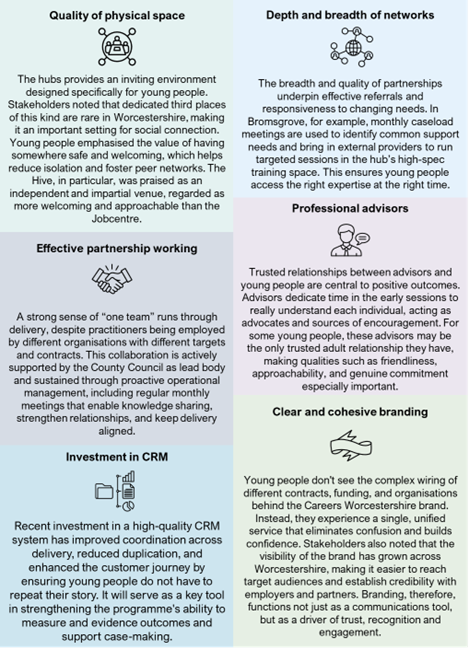
Key drivers underpinning success

The Council sought a strategic and accessible report that brought together the full story of the programme’s impact: an understanding of best practice in delivery, a credible assessment of return on investment, and a clear account of outcomes achieved from the young people who had engaged with the service.

To meet this need, we began by working with the client team to establish a shared framework for the evaluation. Through an inception phase, we reviewed delivery material, monitoring information and programme documentation, and set out an early Theory of Change that captured how Careers Worcestershire is designed to support young people into sustained employment, education or training.

We then undertook a programme of qualitative research with those closely involved in the service. Interviews with Careers Advisors, Wellbeing Coaches, DWP Work Coaches and delivery partners provided insight into how the model operates on the ground, the importance of co‑location and partnership working, and the flexibility required to support young people facing multiple and overlapping barriers. These conversations helped to identify the delivery features that underpin successful outcomes and highlighted areas for continued development.

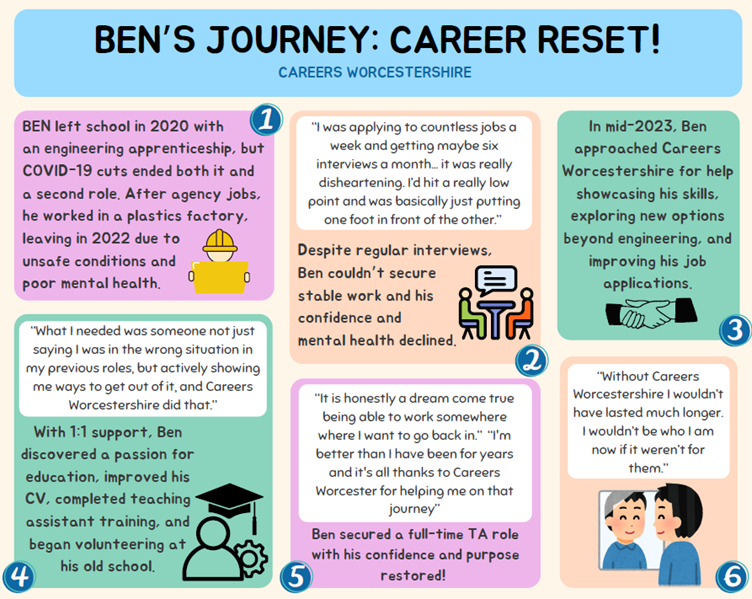
Understanding the experiences of the young people themselves was central to the evaluation. We designed a concise beneficiary survey to explore outcomes such as confidence, work readiness, wellbeing and progression, and complemented this with in‑depth conversations. Through developing and designing visual ‘stories of change’ these accounts brought the evaluation to life, illustrating how young people had developed confidence, built routines, managed anxiety, or found meaningful pathways into work or further learning. Together, these insights demonstrated the breadth of impact the programme has across different types of need and provided key promotional material for the hubs to use and demonstrate programme impact.

Alongside the qualitative research, we carried out detailed analysis of the programme’s monitoring data to quantify participation, engagement, and progression outcomes. Using this evidence, we developed an economic assessment aligned with Green Book principles to estimate the overall return on investment. This included modelling employment‑related and wellbeing impacts, providing a clear and credible view of the value generated through UKSPF investment.

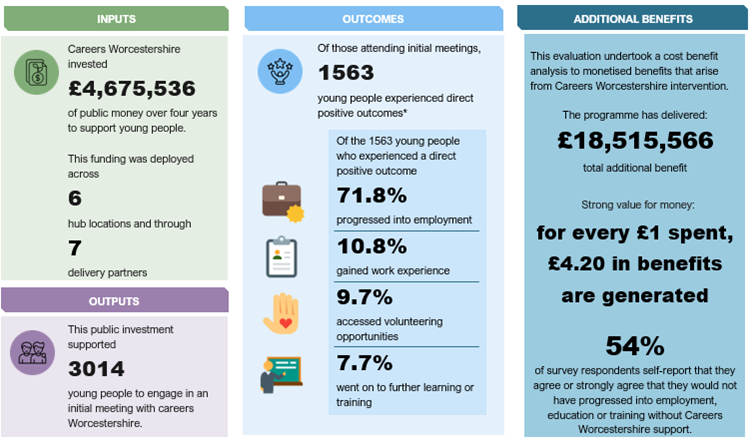
Careers Worcestershire impact in numbers

The final report brought together all strands of evidence into a concise account of the programme’s impact, setting out what Careers Worcestershire has achieved, the factors driving its success, and the strengths of its delivery model. It combined clear quantitative findings, a high‑level economic assessment, and human‑centred stories to illustrate how young people benefit from the support, while also identifying emerging good practice and recommendations to enhance delivery in the future.

The evaluation provided Worcestershire County Council with a clear picture of the programme’s contribution to young people and the wider employability system, offering a strong foundation for future funding and service development.

Evaluating the impact of Homes England’s investment in new homes in Wolverhampton and Croydon

Homes England

Metro Dynamics were commissioned by Homes England to evaluate the Royal Quarter regeneration scheme - a landmark project seeking to revitalise the historic Royal Hospital site into a thriving residential-led community. The investment aimed to tackle critical housing shortages, regenerate a deprived area, and preserve heritage assets within the Cleveland Road Conservation Area. The scheme comprised over 400 new homes, including general social housing, specialist accommodation for older residents and a Y-Living facility operated by the YMCA.

Our work evaluated the impact of the scheme using:

  • Value for Money analysis through cost-benefit modelling.

  • Resident engagement via surveys, interviews, and community events to capture lived experiences.

  • Socio-economic modelling to quantify economic, social, wellbeing and environmental benefits.

  • Stakeholder collaboration with developers, local authorities, and community organisations.

Our evaluation is shaping Homes England’s strategic approach to regeneration and informing how we can deliver impactful, place-based solutions that create social as well as economic value. By contextualising outcomes against external challenges and economic volatility, the findings offer insights that help developers future-proof their projects.

Infrastructure and regeneration financing options assessment

Camden Council

Metro Dynamics and 31ten consulting were commissioned by Camden Council to provide advice on the scale of potential infrastructure investment that Camden Council could unlock through a range of financial tools. Building on the economic impact assessment model that we had developed for Camden previously, which collated development information about the planned Euston Station regeneration works, we built a flexible financial model to test different infrastructure investment tools and mechanisms.

Our final report not only shared findings from our financial analysis, but also provided advice on negotiating for various financing mechanisms with the Greater London Authority and with UK Government, and views on a potential toolkit of financial instruments that Camden could activate to support local investment.

Cambridge Biomedical Council Vision 2050

Cambridge University Health Partners

Metro Dynamics offered support through a series of projects with the Cambridge Biomedical Campus, building from an initial scoping study for a potential CBC vision, to developing a Vision 2050 for the campus as well as leading the subsequent work to begin realising the vision. This included extensive advice on their governance model and legal arrangements, as well as input into and direction for representations to the local planning process. As of Autumn 2021, CBC had been selected as the only location in Greater Cambridge earmarked for an exceptional release of greenbelt land to support further campus development and growth.

We led and managed a team that comprised of 9 expert advisory firms to develop the CBC Vision 2050 into an outward-facing document that describes the ambition of the campus to become an innovation district and life sciences quarter for Cambridge. In addition to drafting the Vision 2050 itself, a dedicated team produced an economic analysis report that assessed the economic significance of the CBC and its role in the wider Cambridge innovation ecosystem; we also completed a community mapping exercise to identify political and community stakeholders for further engagement. The technical studies and appendices that underpin that vision were designed to ensure that the Vision 2050 is deliverable and feasible, offering the best quality development for the campus, its stakeholders and its community. Having developed the Vision 2050, we worked with stakeholders and legal advisors to facilitate and negotiate the establishment of a new company limited by guarantee that would convene and represent the Cambridge Biomedical Campus.

We then developed further technical work with adjacent landowners to develop and manage a series of studies and legal arrangements that would support submissions to the Greater Cambridge Local Planning Authority on behalf of the campus’s future development. The first evidence to support the release of greenbelt land for CBC expansion was submitted to the Greater Cambridge Shared Planning service in April 2021. We developed an enhanced needs case assessment to further convince the LPA: directly addressing concerns related to the scale of development, the necessary mix of development uses, and the character of campus development. We addressed these concerns via a real estate-informed, economic and practical argument for further development at CBC.

We also managed community and political engagement on behalf of the campus, alongside communications experts Counter Context, while also supporting the coordination and improvement of on-site services and amenity in order to promote placemaking and further develop the investable proposition.

Cardiff Bay Arena: Inclusive Growth implementation advice

Cardiff City Council & Centre for Progressive Policy, via the Inclusive Growth Network

Metro Dynamics, with support from Centre for Progressive Policy, was commissioned via the Inclusive Growth Network to provide advice on how inclusive growth principles could be embedded in the development of a new arena at Cardiff Bay. Cardiff City Council intends to ensure that the Arena development supports and embeds their ambitious inclusive growth plans, bringing maximum economic benefit to the local communities with some of the highest levels of deprivation in the city.

Our work involved desk-based review of Wales and Cardiff-level policy, identifying case studies of best practice in developments of this type elsewhere in the UK, selected analysis of deprivation and employment challenges in the local area, and mapping of and engagement with local stakeholders and organisations.

Our final report set out a number of staged recommendations for inclusive growth interventions in four themes (residents, employment, the creative ecosystem, and use of physical space). The recommendations will be taken forward by the council and partners to maximise the social and economic benefit of forthcoming development and the subsequent regeneration of the wider Atlantic Wharf area.

Sustainable & Inclusive Economic Plan

Enterprise Cheshire & Warrington

Building on our long-term partnership with Enterprise Cheshire and Warrington (formerly Cheshire & Warrington LEP) we are working on a plan to achieve the vision set out by the Sustainable & Inclusive Growth Commission. Building on previous work identifying industrial strengths, building an evidence base and engaging a wide range of stakeholders the plan sets out four missions and priority areas to make Cheshire and Warrington the healthiest, most sustainable, inclusive, and growing economy in the UK by 2045. Primarily an economic plan it will focus on delivering economic growth that will reduce inequalities and enable the sub-region to achieve its Net Zero target.

Inclusive Economic Strategy

Durham County Council

Metro Dynamics have worked with Durham County Council and partners to develop an Inclusive Economic Strategy for the county. This sets out an ambitious long-term plan for County Durham’s economy. It goes beyond a traditional economic strategy and aims to create more and better jobs in an inclusive, green economy through the five Ps: People, Productivity, Places, Promotion and Planet. 

This was a highly collaborative process whereby we codeveloped the document with the Council and partners and has strengthened collective working across the county.

East Birmingham & North Solihull

Birmingham City Council & Solihull Metropolitan Borough Council

We have been retained over a series of commissions throughout which we have defined, advocated for, and begun to implement a new strategic approach to driving inclusive economic growth in East Birmingham & North Solihull (EBNS).

EBNS is a young, vibrant, socially, culturally, and economically diverse part of the West Midlands, comprised of 25 wards with a total population of more than 370,000 residents. The area is a major growth priority for the UK, with HS2, UK Central and other major employment sites within and around the area creating the potential for a decade of renewal and opportunity. While the communities of EBNS are diverse and differentiated, they also face some shared challenges. Deprivation is consistently high across the corridor, health outcomes are poor, and physical connectivity to economic and social opportunity is limited.

We established a shared programme of work between Birmingham, Solihull and the West Midlands Combined Authority to scope the role for new powers and tools through the Trailblazer Deeper Devolution Deal to support enhanced investment and intervention in the area. Through this work and subsequent negotiations we agreed to bring together:

  • A new form of governance for the area with political and officer engagement from the two local authorities and partners delivering services across the area;

  • Enhanced infrastructure delivery focus, including a number of sites ringfenced for enhanced local business rate retention; and

  • A vision for and pilots-based approach to public services delivery focused on long-term public service savings.

We facilitated extensive engagement, analysis and advocacy to secure buy-in to the EBNS area of opportunity, and to secure business rate retention powers across a series of strategic sites throughout the corridor. Most recently, this has involved developing a long-term investment strategy for EBNS which distils an outcomes-based approach to intervention in the area, as well as priorities for investment and intervention.

Economic impact assessment for Euston Station regeneration

Camden Council

Metro Dynamics worked with the London Borough of Camden between 2023 to early 2026 to produce an initial Economic Impact Assessment (EIA), accompanying strategic narrative and document refresh for the Euston Area regeneration.

Euston Station’s importance and strategic location make this one of the UK’s most significant development opportunities. Notwithstanding work to develop a broad Growth Strategy for Euston back in 2016, this work was the first time that an attempt was made to fully quantify and articulate the strategic impact and economic benefits of Euston’s redevelopment on local, London-wide, and national scales. The aim was to provide a clear view of the opportunity at a critical time for the project, following the Government’s decision that completing the Euston Station HS2 terminus would require substantial private investment.

The Economic Impact Assessment was based on a development scenario for Euston that development partners had prepared in response to the Government’s objectives for the development.

Our original study assessed the transformational economic and place-making opportunities linked to the Euston station broader area redevelopment, which has the potential to contribute 34,000 jobs, 2,500 homes, and £41bn to the economy by 2053. This included the economic value generated from the development in terms of construction, but also operational benefits of new office and lab space, alongside wider socio-economic analysis of placemaking and the potential health benefits from improved affordable housing.

As part of the economic model, Metro Dynamics also tested a range of scenarios for development, to demonstrate how the benefits could vary for larger, taller, and smaller developable areas, and faster development, providing confidence in the assessment of the best way forward.

 
Metro Dynamics have been a pleasure to work with. From the outset they interpreted the brief clearly and succinctly and tailored the outputs to meet the budget and the needs of the Council. The team were professional, knowledgeable and communicative at all times and friendly too.
— Mary-Ann Lewis, Head of Euston Regeneration, Camden Council

Advocacy for future devolution policy

Future Governance Forum

Metro Dynamics has been working with new think tank the Future Governance Forum to develop devolution policy to support advice for an incoming government following the general election around furthering devolution in England. We have worked with a range of stakeholders from think tanks, academia, and leaders in central and local government to understand how deeper devolution to places in England might be achieved in the coming years, with the aim of supporting fair and green economic growth and supporting people to live healthy, prosperous lives.

We have published a joint policy paper on economic devolution that makes specific recommendations on how further and wider devolution can boost economic growth with flexibilities and leadership in our growth engines across the country. Report can be accessed here: Impactful Devolution: A new framework for local growth and national renewal July 2024).

Accelerating innovation projects in Greater Manchester

Greater Manchester Combined Authority & Innovation Greater Manchester

Metro Dynamics has worked with GMCA and IGM through a series of projects to help pursue place-based innovation ecosystem development and investment. IGM is a consortium of Manchester-based businesses, universities and public authorities working together to support the regional innovation economy.

We started by rapidly assessing projects in IGM’s delivery pipeline via a bespoke prioritisation framework which scored projects in four domains: strategic fit, innovation fit, outputs and outcomes, and investment readiness. We then produced summary balanced scorecards for each of the projects and delivered a gap assessment of projects in the pipeline. Finally, we provided GMCA a short briefing which showed the performance of the projects against success criteria, implications for a representation to Spending Review, as well as actionable next steps for developing the projects in the pipeline further.

We used these projects and this assessment as the platform to advocate for devolved innovation funding an autonomy leading to the announcement of the Innovation Accelerator pilot in February 2022. We then supported GMCA and IGM in assessing and selecting a portfolio of Accelerator projects. This first required soliciting project ideas from partners across the region, then reviewing these against a funding round-specific assessment process. Metro Dynamics did not provide recommendations on which projects would ultimately receive funding, instead we acted as an independent critical friend to the review process, including facilitating an expert panel to take input on the projects from a range of research, academic and private sector innovation and commercialisation experts. Our team also facilitated GMCA’s decision making panel, a small group of regional officers who were responsible for selecting the portfolio of projects, with observers from Innovate UK.

More recently, we have provided rapid analytical support to assess the strengths and weaknesses of Greater Manchester’s innovation ecosystem to help support GM’s Innovation Plan, to inform IGM’s future remit and operating model, and to help inform early design work around the GM Investment Zone. Our findings were reported to the board of Innovation Greater Manchester to inform the next stage of their operations. We also used our assessment of the innovation economy and provision across the region to provide options for a future governance structure for IGM, including options assessment on board membership, staffing, and the role of IGM in future funding processes. We concluded this review with recommendations on next steps for IGM board members and GMCA officers to agree and take forward.

Inclusive Growth Commission

London Borough of Barking and Dagenham

LBBD established an independent Inclusive Growth Commission bringing together ten experts from fields including urban planning, business, heritage and the arts, local government, and the labour market. Metro Dynamics was commissioned to provide support to the Inclusive Growth Commission, which took the form of preparing briefing reports, organising and facilitating meetings, and consulting with a wide variety of stakeholders and stakeholder organisations through workshop sessions and interviews.

The Commission prepared a final report with detailed recommendations to the Borough on how to create and build the opportunities that are in, and those that will come to it in the next decade. A series of ambitions to raise the socio-economic performance of the Borough were also outlined.

Pan-London Economic Recovery Framework

London Councils

London Councils commissioned Metro Dynamics to support a Covid-19 recovery framework for London Boroughs in 2022. The overarching aims of the strategy were to: establish a London narrative for recovery with inclusive, economic growth at its centre; strengthen partnership working between boroughs, Sub-Regional Partnerships and the GLA; and lay the groundwork for a subsequent London-wide recovery deal with Government.

Initial steps involved the creation of a city-wide Covid impact evidence base, emphasising the implications of the ‘Zoomshock’ effect, assessing the implications on different London boroughs. This was supported by a review of current policies and interventions designed to support London’s recovery through its ‘9 Missions’. This informed a scenario building exercise, reflecting city-wide thinking about the future of London, alongside our own insights from working with other cities and places. The evidence, policy review, and scenario building all supported our final report and recovery framework. This framework contained a robust set of economic interventions that could support London in achieving a sustainable renewal from Covid-19; we also outlined a set of recommendations in how to implement these interventions, centring on a partnership approach and ‘London as a System’.

Meanwhile, in parallel to this work, we conducted an extensive programme of senior stakeholder engagement with borough Leaders, Sub-Regional Partnerships, GLA senior officers, and business representatives. This engagement helped us better understand the impact of the pandemic and local priorities for the future. Upon completion of the report, we continued that engagement, sharing our narrative, findings and recommendations with senior groups and executive growth directors.

Interim evaluations of Strategic Investment Fund projects

Liverpool City Region Combined Authority

Metro Dynamics was commissioned by Liverpool City Region Combined Authority (LCRCA) to conduct interim evaluations of two Strategic Investment Fund projects: the Future Innovation Fund and the Flexible Growth Fund. The evaluations sought to understand the delivery effectiveness and early impacts of the Funds, as well as provide evidence-based recommendations and lessons to take forward for future phases of the Funds as well as future interventions designed to support innovation-led growth.  

In line with HM Treasury Magenta Book guidance and working closely with LCRCA, we developed a Theory of Change for each Fund which provided the framework for the evaluation. We then implemented a mixed method approach, composed of desk-based research, semi-structed interviews, quantitative online surveys and analysis of Fund performance data, to draw out key learnings and create a compelling narrative of how each intervention delivered change. 

The final reports set out the analysis of Fund delivery effectiveness, management, impact and value for money. Recommendations centred on exploring mechanisms for maximising social value of LCRCA investment and a more targeted approach to promotion in order to increase the reach of funding opportunities across the local authorities. 

The evaluation reports were complemented by strategic overview report which drew on socioeconomic analysis to contextualise the evaluation findings within the wider economic and policy landscape. 

Liverpool City Region Housing Initiative

Lloyds Banking Group

Working with Lloyds Banking Group, the non-profit Young Foundation, and partners across the city region, Metro Dynamics has been exploring innovative approaches to financing and accelerating social and affordable housing delivery. This included working with the Young Foundation developing a comprehensive evidence base highlighting the distinctive housing market challenges in the region: low land values, limited new affordable housing delivery, and poor housing outcomes as a result of an older and highly energy inefficient housing stock.

We went on to facilitate extensive engagement with the Combined Authority, Local Authorities, and Housing Associations in the region to scope issues and options for a new approach. We were able to identify and develop a pipeline of housing sites and schemes that have the potential to provide additional social value to residents, as well as open dialogue with Homes England about potential options including via the Strategic Place Partnership.


Health & Wealth deepdive

Lancashire Independent Economic Review

As part of the Independent Economic Review we led a deep dive into Health, Wealth & Wellbeing. The report made the case for investment in health and prevention to deliver productivity gains. It explored the health inequalities between different parts of Lancashire, and identified where in the life cycle these occur to evidence where investment could have greatest impact. We looked at the social determinants of health and health innovation, and recommended areas of intervention and systems change. 

Read our findings here.

Investment Framework

North East Combined Authority

Our team was embedded with the new North East Combined Authority to scope, design and draft a strategic Investment Framework for the new CA in the runup to its official establishment. The work involved extensive engagement across the seven local authorities that comprise the North East CA, including both officers and members, as well as managing work by the RSA to engage with business, education and VCSE stakeholders from across the region.

The Investment Framework is based on financial information and principles developed with finance officers, reflecting the scale of financial resource available to the new CA – including its £1.44bn 30-year investment fund as well as other devolved regional funding. The Framework is built on a theory of change-based approach, as well as extensive socioeconomic evidence from within the region.

Evaluation of the Enterprise Fellowships programme

Royal Academy of Engineering

Metro Dynamics was commissioned by the Royal Academy of Engineering to conduct an economic evaluation of the Enterprise Fellowships programme which supports start up and spin out founders through equity funding, training and mentoring. The evaluation sought to understand programme impact and contribution to national prosperity, competitiveness and value for money.

We used a theory-based approach, undertaking over 40 in-depth interviews with stakeholders, alumni and unsuccessful applicants to robustly test programme logic to draw out what impacts are being generated, for who and why. Findings were triangulated by an online beneficiary survey, quantitative analysis of performance data and a value for money assessment, using published results from quasi-experimental studies of business support programmes to estimate lower bound impacts. 

A rapid market review helped shape solidify a shared understanding of programme USP, the narrative from which has been used by the Royal Academy of Engineering to support the marketing of the Enterprise Fellowships and articulate its value to funders.

Evaluation findings confirmed the success of the Enterprise Fellowship programme in accelerating the translation of engineering innovations and supporting market leading enterprises that deliver substantial social economic benefit. Recommendations therefore centred on strategic opportunities and supporting the Royal Academy of Engineering to fully maximise the potential of the Academy’s assets and network. 

Mapping the Innovation Economy in Surrey

Surrey County Council

Metro Dynamics worked with Surrey County Council to map the spatial distribution of Surrey’s innovation economy. Following a baseline review of national data on the sector make up of Surreys economy and relevant local strategies and policy documents we used data from Data City to map the economic geography of emerging economy businesses.

After agreeing a list of priority sectors and key complementary sectors/technologies to these priorities we mapped the economic geography of individual sectors, overlaying key innovation assets and transport routes. Using a spatial clustering algorithm (DBSCAN) we identified areas with concentrations of businesses in these emerging sectors. This cluster analysis identified several innovation areas in Surrey: places with concentrations of activity in at least one emerging economy sector. This was combined with a wider review of the assets and infrastructure in these places, enabling us to categorise the areas based on the likely support needs of their innovation ecosystems.

North West Space Cluster strategy and vision

Science & Technology Facilities Council

Building on an initial strategic case, Metro Dynamics first created an evidence base that strengthened the rationale for developing a Space Cluster, analysing the market trends of the evolving UK space sector and assessing how the strengths of the North West underpinned major opportunities within the space economy. This evidence guided the development of a vision for the Space Cluster in the North West, a set of strategic objectives and delivery principles, and target market opportunities that will drive growth in the region. Supporting the strategy was an implementation plan, developed in collaboration with the Space Cluster Leadership Group, outlining a set of initial priorities to support the set-up and early delivery of the cluster. 


Our cluster strategy highlights an exceptional opportunity for the north-west region, using space as an attractor that leverages local strengths, such as digital, advanced materials and defence. This will enhance their economic impact across the UK and competitiveness at a global scale.
— Dr. Barbara Ghinelli, Director of Cluster Development at Science, Technology and Facilities Council

Plan for Growth

South Yorkshire Mayoral Combined Authority

As part of the development of the South Yorkshire Mayoral Combined Authority (SYMCA) Plan for Good Growth, Metro Dynamics were commissioned by SYMCA to understand the barriers to growth in South Yorkshire, which informed the direction and focus of the plan. The final output from this work had been published as an accompanying evidence base to the plan here.

With a focus on understanding growth and constraints on growth, our wide-ranging analysis in this project explored factors including tradable jobs, economic complexity, investment, the innovation ecosystem, and economic and social infrastructure. 

Designing and negotiating the Trailblazer Deeper Devolution Deals

Greater Manchester Combined Authority & West Midlands Combined Authority

Metro Dynamics advised through two separate teams the GMCA and WMCA strategy teams at the forefront of deepening devolution with the development of their Trailblazer Devolution Deals announced at Spring Budget 2023.

We worked with officers to support development of policy options including for fiscal devolution, developing the Single Settlement, and Levelling Up Zones and Investment Zones. We worked with Combined Authority policy teams to support refining and finalising proposals and deal text, and negotiating and agreeing deal points across government departments.   

Opening the Innovation Economy

UK Innovation Districts Group & Connected Places Catapult


Working with Professor Neil Lee of LSE and other expert partners, Metro Dynamics undertook research to establish the case for inclusive innovation whilst also taking an analytical approach to assess several best practice programmes and projects contributing to this agenda. It was facilitated by deep dive engagement with 11 innovation districts in the UK, as well as MaRS Toronto, investigating inclusive activities being led by innovation districts already. The commission supports a national conversation about the role of inclusive innovation in sustainable and equitable economic development.


This research, jointly commissioned by the UK Innovation Districts Group and Connected Places Catapult, has examined where places are successfully doing just that. It is critical that we, as innovation districts leaders and policymakers, understand the building blocks that create thriving, inclusive, and sustainable local innovation economies and how these can be delivered at scale.
— Emma Frost, Chair, UK Innovation Districts Group

Birkenhead and Liscard Town Centres regeneration business cases

Wirral Council

Metro Dynamics was commissioned by Wirral Council to develop their £25m Town Deal business cases and a £10m DLUHC funding bid for Liscard town centre regeneration. The town centre regeneration projects encompassed a suite of cultural, heritage and creative, education, workspace, and public realm projects designed to re-animate Birkenhead town centre and Wirral Waterfront and revitalise Liscard high street while unlocking the commercial viability for new residential development opportunities.

The Metro Dynamics team supported Wirral Council in making compelling cases for investment, ensuring the projects were viable, deliverable, and impactful from the outset. We engaged with a wide array of partners, including National Museums Liverpool, Wirral Chambers, Peel Holdings, and local enterprise and charity organisations, to aid in developing various project elements and conducting due diligence to ensure commercial viability, deliverability and robust economic cases. All business cases were approved by the Council, acting as the accountable body, and £25m funding was approved by DLUHC. Additionally, the Liscard funding bid was successful, securing £10m Levelling Up Fund from DLUHC.

Mobilising the Plan for Growth

West Midlands Combined Authority

Metro Dynamics were commissioned by the West Midlands Combined Authority to develop a delivery plan to mobilise the three highest growth potential cluster opportunities set out in the Plan for Growth Strategy – electric vehicles and associated batteries, logistics and distribution, and smart energy systems. This work focused on assessing where each cluster was in its development journey and identify what is required to deliver commercial growth by 2030. 

Through the development of a cluster development framework, and by working with individual cluster leads, including Logistics UK, Warwick Manufacturing Group, and Energy Capital, a set of interventions were developed to set out how the Combined Authority should focus investment and programmes to support cluster growth. Alongside this we helped set up formalised working groups, establishing the governance to oversee the development of each cluster and drive forward recommended action.

Evaluating the impact of engineering enterprise support: Royal Academy of Engineering Enterprise Fellowships

Royal Academy of Engineering

Metro Dynamics was commissioned by the Royal Academy of Engineering to conduct an economic evaluation of its Enterprise Fellowships programme, which supports start‑up and spin‑out founders through equity funding, training and mentoring. The programme plays a critical role in accelerating the commercialisation of engineering innovation and strengthening the UK’s innovation‑led economy.

The evaluation sought to understand the programme’s impact and contribution to national prosperity, competitiveness and value for money, and to provide robust evidence to inform future programme development and funding decisions.

Our work evaluated the impact of the programme using:

  • A theory‑based evaluation approach to test how and why impacts are generated

  • Over 40 in‑depth interviews with stakeholders, fellows and unsuccessful applicants

  • An online beneficiary survey to quantify outcomes and experiences

  • Quantitative analysis of performance and monitoring data

  • A value for money assessment drawing on published quasi‑experimental evidence from comparable business support programmes to estimate lower‑bound impacts

Alongside the evaluation, we undertook a rapid market review to develop a shared understanding of the programme’s unique offer. This helped sharpen the narrative around the Enterprise Fellowships and has since been used by the Royal Academy of Engineering to support marketing activity and articulate the programme’s value to funders.

The evaluation confirmed the success of the Enterprise Fellowships in supporting high‑potential engineering ventures, accelerating innovation and generating substantial social and economic benefits. Our recommendations focused on strategic opportunities to strengthen delivery and on how the Academy can fully maximise the value of its assets, networks and convening power. The findings provide a strong evidence base to support future investment and the continued evolution of the programme.