
Understanding the impact of Careers Worcestershire youth employability support
Worcestershire County Council
Metro Dynamics was commissioned by Worcestershire County Council to deliver an independent impact evaluation of Careers Worcestershire, a youth employability programme supporting 16–24-year-olds who are NEET or at risk.
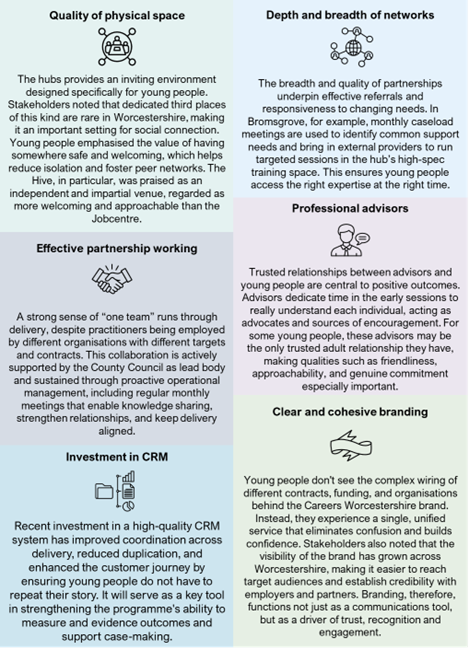
Key drivers underpinning success
The Council sought a strategic and accessible report that brought together the full story of the programme’s impact: an understanding of best practice in delivery, a credible assessment of return on investment, and a clear account of outcomes achieved from the young people who had engaged with the service.
To meet this need, we began by working with the client team to establish a shared framework for the evaluation. Through an inception phase, we reviewed delivery material, monitoring information and programme documentation, and set out an early Theory of Change that captured how Careers Worcestershire is designed to support young people into sustained employment, education or training.
We then undertook a programme of qualitative research with those closely involved in the service. Interviews with Careers Advisors, Wellbeing Coaches, DWP Work Coaches and delivery partners provided insight into how the model operates on the ground, the importance of co‑location and partnership working, and the flexibility required to support young people facing multiple and overlapping barriers. These conversations helped to identify the delivery features that underpin successful outcomes and highlighted areas for continued development.
Understanding the experiences of the young people themselves was central to the evaluation. We designed a concise beneficiary survey to explore outcomes such as confidence, work readiness, wellbeing and progression, and complemented this with in‑depth conversations. Through developing and designing visual ‘stories of change’ these accounts brought the evaluation to life, illustrating how young people had developed confidence, built routines, managed anxiety, or found meaningful pathways into work or further learning. Together, these insights demonstrated the breadth of impact the programme has across different types of need and provided key promotional material for the hubs to use and demonstrate programme impact.
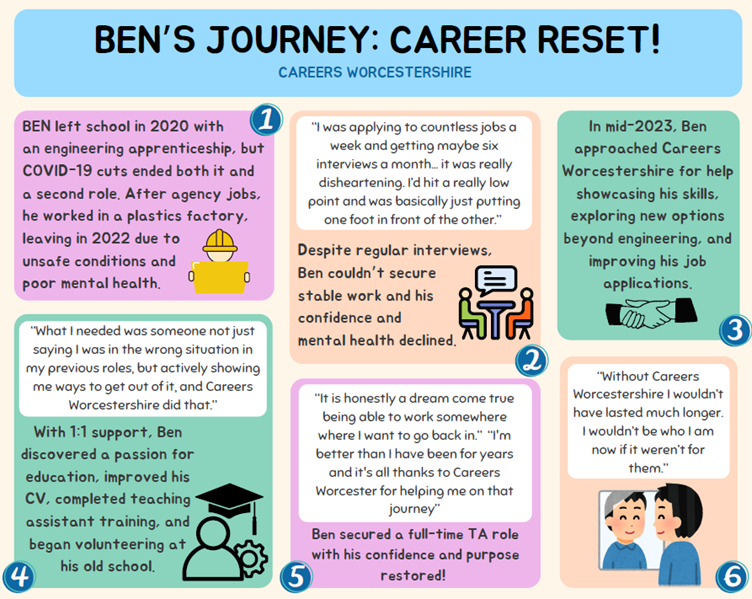
Alongside the qualitative research, we carried out detailed analysis of the programme’s monitoring data to quantify participation, engagement, and progression outcomes. Using this evidence, we developed an economic assessment aligned with Green Book principles to estimate the overall return on investment. This included modelling employment‑related and wellbeing impacts, providing a clear and credible view of the value generated through UKSPF investment.
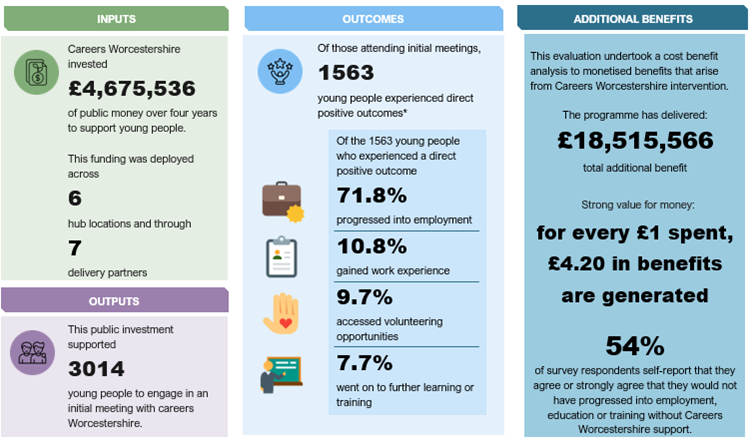
Careers Worcestershire impact in numbers
The final report brought together all strands of evidence into a concise account of the programme’s impact, setting out what Careers Worcestershire has achieved, the factors driving its success, and the strengths of its delivery model. It combined clear quantitative findings, a high‑level economic assessment, and human‑centred stories to illustrate how young people benefit from the support, while also identifying emerging good practice and recommendations to enhance delivery in the future.
The evaluation provided Worcestershire County Council with a clear picture of the programme’s contribution to young people and the wider employability system, offering a strong foundation for future funding and service development.